
An AI colleague in Nestr is not a chatbot with permissions bolted on. It fills a role, and everything about how it behaves follows from that: what it works on, what it may reach, when it acts on its own, and what it does when a piece of work is not its to do.
This article covers the two things that decide how an agent behaves in practice: cadence, which is when it acts, and alignment, which is what keeps its work pointed at the organisation's intent rather than at whatever the last message happened to say.
Every agent responds when something addresses it: an @mention, a direct message, or being assigned a piece of work. That is the default and it never goes away.
On top of that you can set an agent autonomous so it also picks work up by itself, on a cadence. This is additive. An autonomous agent still answers when you talk to it; it simply does not wait to be asked before making progress.
A dated item outranks the cadence entirely. If work carries a due date, that date is the statement about when it is wanted, and the agent acts then rather than on assignment.
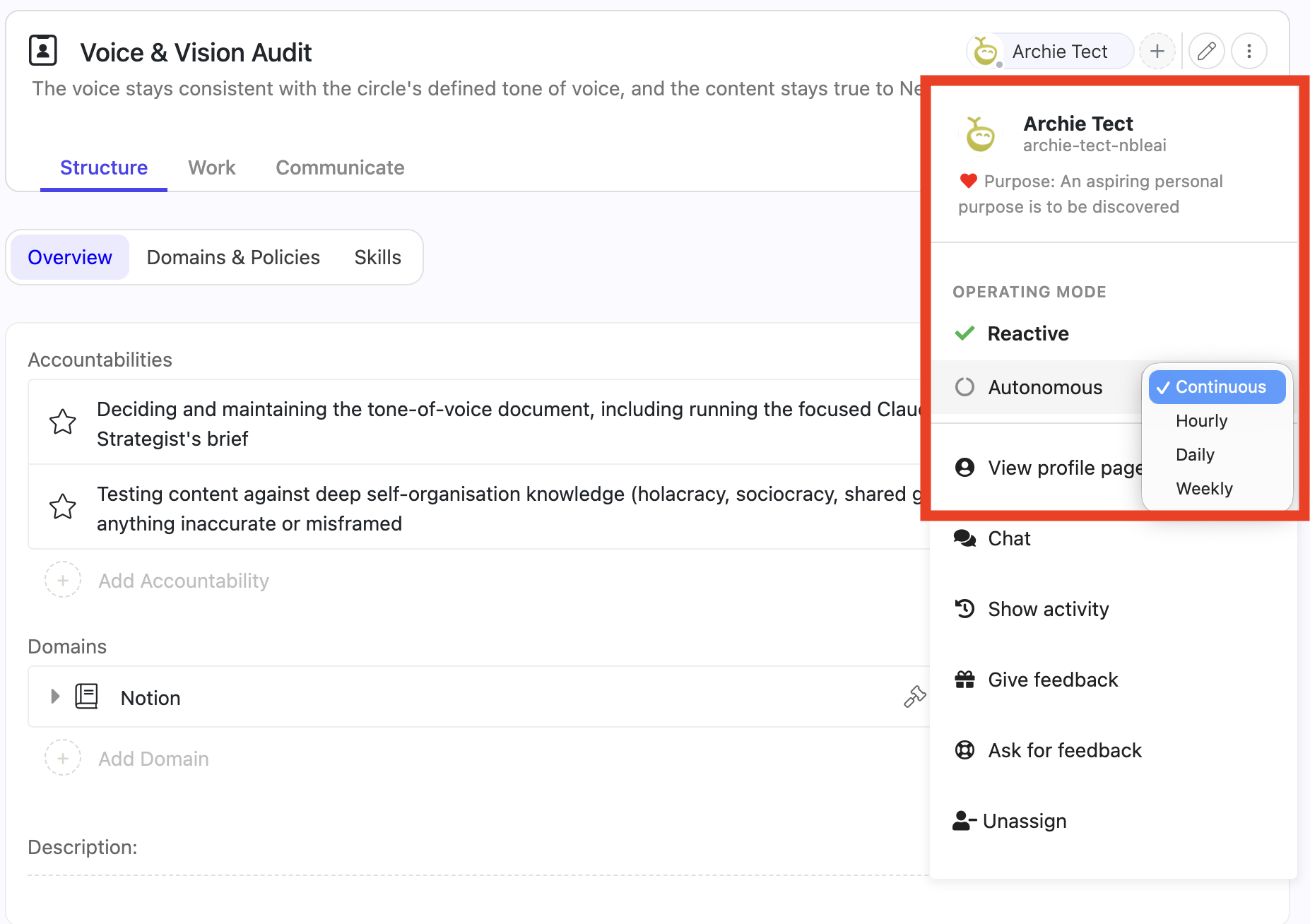
Open any role, project or task the agent fills or is assigned to, and click the agent's avatar. The menu that opens has an Operating mode section with two rows:
You can also ask the assistant in the help chat to run an agent for you. It starts the run and links you to the page where the agent reports back.
Cadence is inherited. Set an agent autonomous on a whole role or circle and everything under it follows, then override on a single project or task where you want something different. That is the usual shape: a role runs daily, one urgent project inside it runs continuous.
A cadence is set for an agent on one item and re-checks that item until it is done. That keeps an open-ended role or project moving, but it does not repeat a job: a task on a weekly cadence stops once it is completed. For a specific job at a set time, such as a weekly report or a monthly reconciliation, use a repeating task instead. Create it under the role, assign the agent, give it a due date (and a start time when the time of day matters), and set it to repeat. Each occurrence runs the agent when it comes due, says exactly what to do, and shows on the role's board where the rest of the circle can see it. See recurring meetings and tasks.
Autonomous agents are capped. If an agent re-runs on the same item far more often than its cadence implies, Nestr drops that assignment back to reactive and reports it, rather than letting a wedged loop burn credit unnoticed. An agent that stops making progress stops running.
This is the practical answer to agent sprawl: proactive work is bounded by a cadence you chose, a cap you did not have to think about, and a credit balance you control.
An agent that can act on its own needs something to act towards. In Nestr that is not a system prompt somebody wrote once. It is your existing organisational structure, read fresh on every run.
Every circle carries a purpose, and an agent working inside that circle is given it. Purpose is the compass: when a request is ambiguous, or two reasonable courses of action are open, purpose is what the agent reasons from. An organisation that has done the work of writing clear purposes gets better agent behaviour for free, because the same clarity that helps people helps agents.
Where a circle has set a strategy, the agent reads it. Purpose says why the circle exists; strategy says what it is currently prioritising. That distinction matters more for an agent than for a person, because a person absorbs current priorities from the room and an agent only knows what the organisation has written down. Keeping circle strategy current is one of the highest-leverage things you can do for agent quality.
The role's accountabilities are given to the agent on every run. They are the concrete statement of what this role is on the hook for, and they are what the agent uses to judge whether a piece of work belongs to it. Vague accountabilities produce agents that overreach or stall, for the same reason they produce humans who do.
Skills attached to a role are its working knowledge: how this organisation does this particular thing. They load on demand when that role is working, rather than sitting in context permanently, so a role can carry real depth without every run paying for it.
Workspace-wide context files, such as a constitution or handbook, are the broadest layer and apply to everything. Keep them short. Anything that only matters to one role belongs on that role as a skill instead. See the Agentic work app.
Together these are your alignment surface, and all of it is ordinary organisational structure. You do not tune an agent by editing prompts. You tune it by making the organisation clearer, which is work worth doing whether or not an AI ever reads it.
An agent filling a role acts on that role's authority and nothing more. It uses the connectors that role's domain has been granted, works on what the role is accountable for, and its changes are recorded against the role. See connectors for AI agents.
Each of those connectors also carries an audience: who may get the agent to use it on their behalf. It starts open to the workspace, and narrowing it to a circle, a role or named people is a governance edit on the domain. The agent is not asked to honour it. A connector the asker is not in the audience for is never handed to the agent in the first place, so no request, however it is phrased, reaches it.
An assistant is the mirror image. It acts as the person it is helping, with exactly that person's permissions, and it can never exceed them. An agent only ever assists a person, never another agent, so authority cannot be chained through a series of agents until nobody can say where it came from.
The two are exclusive. An agent either fills a role or assists a person, decided by the Assignable to roles setting on the agent itself.
The most useful thing an agent does with a boundary is stop at it.
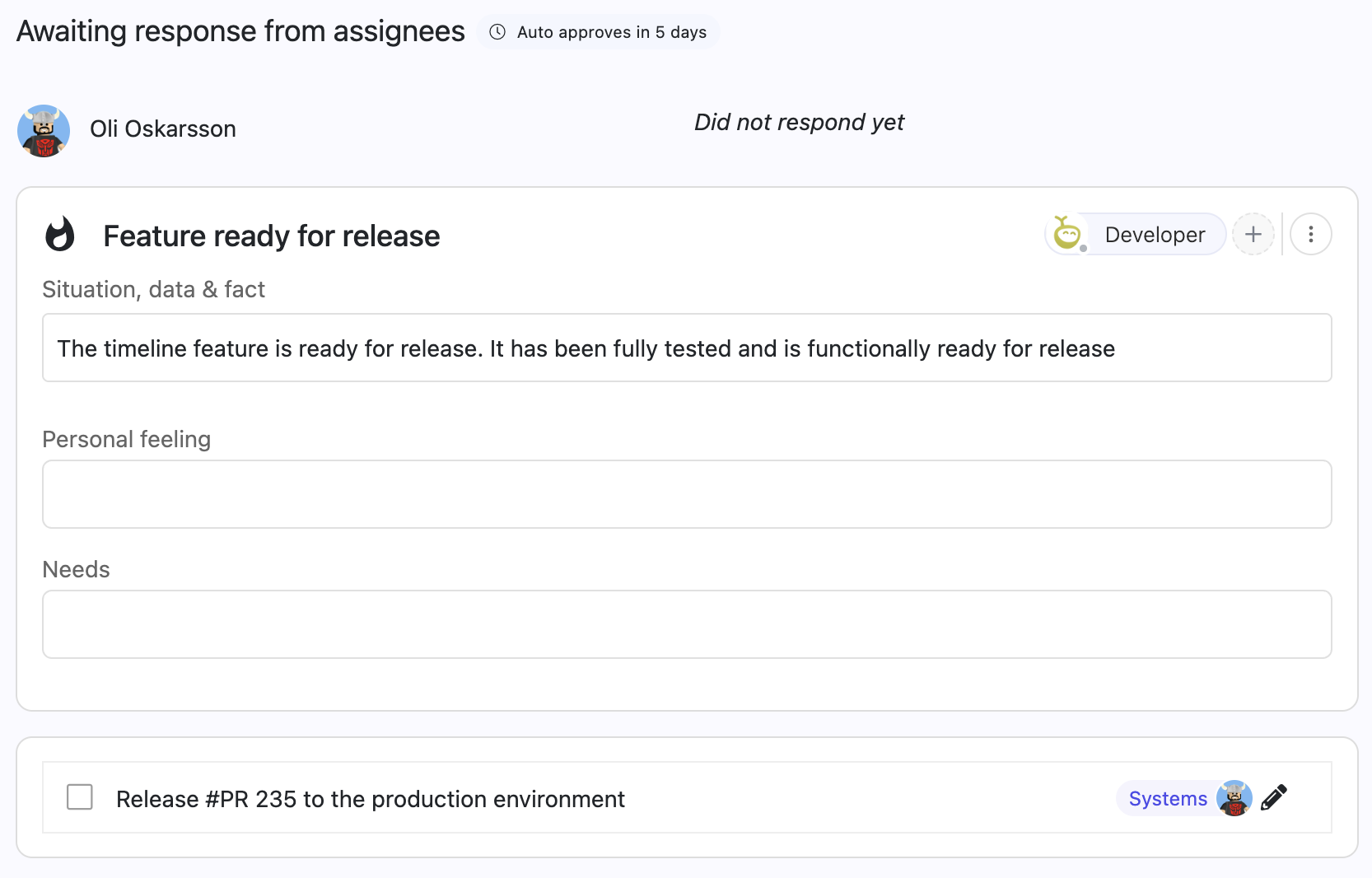
When work belongs to another role, the agent hands it over rather than doing it anyway. It can assign work to the role that owns it, raise a tension for something that needs a governance decision, or bring a person in by name. The receiving party may be a human filler or another agent; the agent does not need to know which, because it is addressing the role.
Where an action is gated behind approval, the agent pauses and asks in the conversation, then resumes when somebody with the authority answers. It does not proceed on silence.
This is what makes agentic orchestration work at more than one agent. Work moves between roles the way it always has in a role-based organisation, and whether a given role is filled by a person or an agent is not something the sender has to think about.


.png)


