Start working on Purpose today
Unpack your purpose into clear roles so that everyone can effectively contribute to making your purpose a reality without the burden of slow management hierarchies and bureaucracies.

Nestr is a collaboration platform for Purpose-Driven work using self-organization and the power of AI.
Trusted by innovative organizations worldwide for greater agility, productivity, AI Agent collaboration, and alignment with organizational purpose.
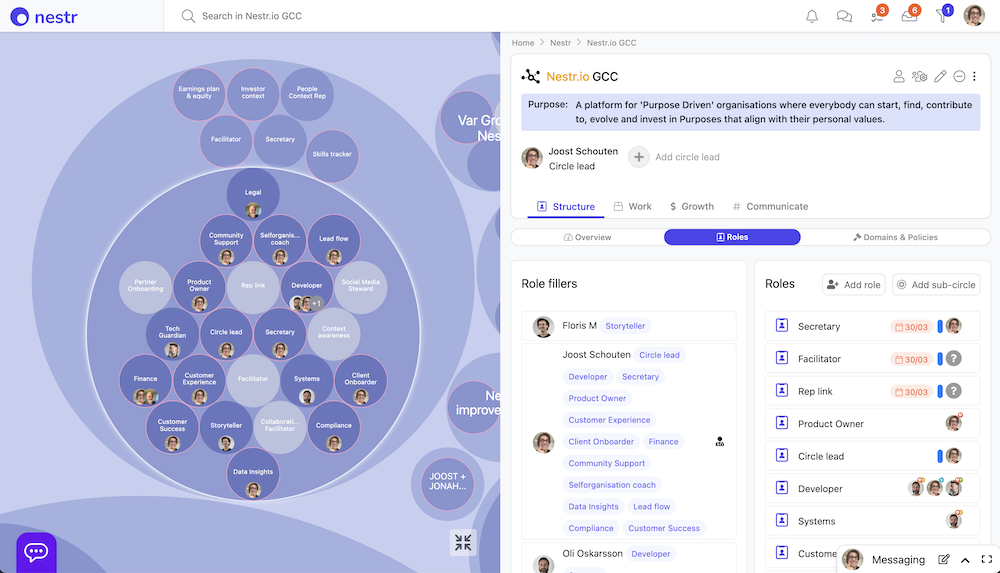
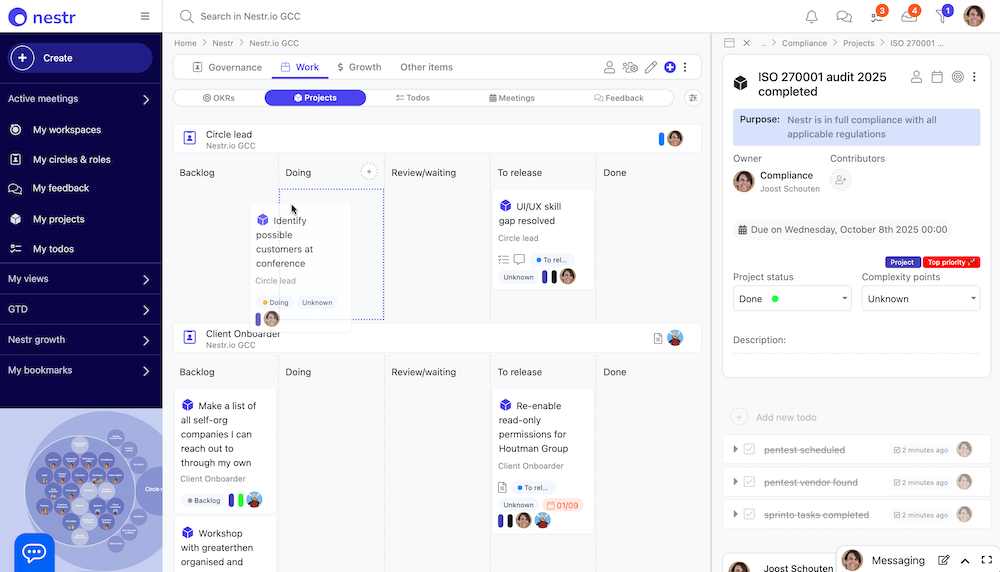
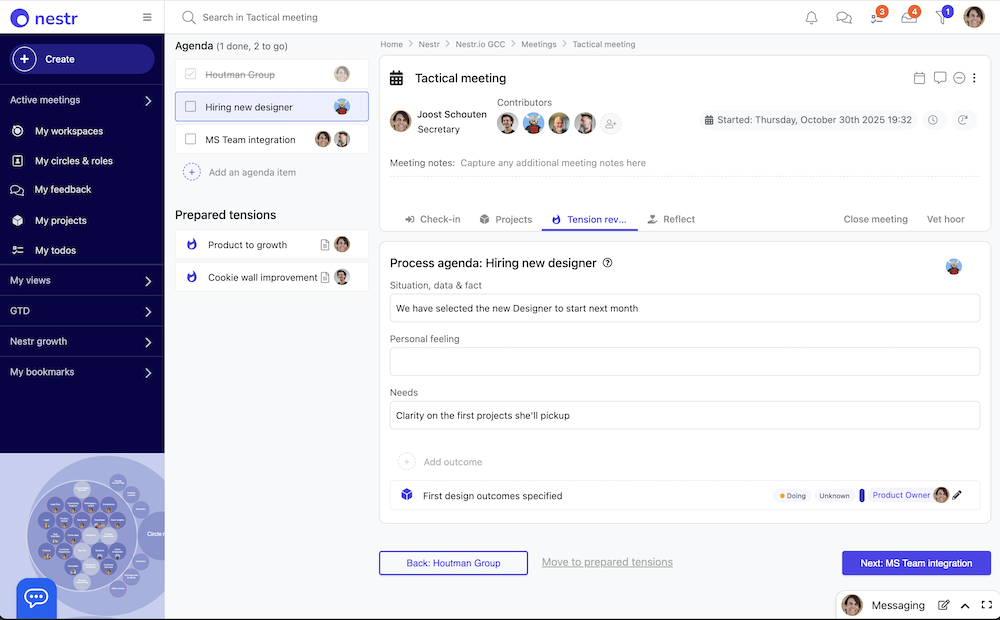


.png)
Nestr is a role-based collaboration platform for self-managing organisations. Teams define circles, roles, and accountabilities, run governance meetings, process tensions, and manage projects without traditional management hierarchies.
Nestr is also the governance layer for agentic work: AI agents can be full members of your organisation, assigned to roles with defined purpose and accountabilities, so they operate effectively and ethically alongside your human team
Holacracy is a governance framework that distributes authority across defined roles and circles rather than a management hierarchy. Nestr supports Holacracy natively with governance meetings, tension processing, role elections, and circle management built in.
Both distribute authority through circles and roles. Holacracy uses a constitution-based rule set with tension-driven governance; Sociocracy uses consent-based decision-making and equivalence between members. Nestr supports both, plus Teal and custom approaches.
Nestr offers a free Personal plan and paid plans starting at €7 per user per month (or €70 per year) for Starter, and €12 per user per month (or €120 per year) for Pro. Prices are in EUR for Europe and USD elsewhere. A 17-day free trial is included on paid plans, no credit card required.
Traditional org charts show reporting lines. Nestr captures live organisational structure. Who holds which role, what each role is accountable for, what circle it belongs to, and what tensions or projects are active. Importantly, people often fill multiple roles across different circles, so they can appear in several places in the structure simultaneously. It is a working governance system, not just a static diagram.
Yes. Nestr has a native MCP (Model Context Protocol) integration, allowing AI agents to read and act within your organisational structure. Agents can understand roles, circles, accountabilities, and governance context to take autonomous actions within defined boundaries.
Role-based work means organising around clearly defined roles with explicit accountabilities rather than job titles or reporting lines. Each role has a purpose, specific accountabilities, and a domain. People can fill multiple roles, within one circle or across several. The organisation evolves by creating, updating, or removing roles as work demands change.
Yes. In Nestr, AI agents can be full members of your organisation. Assigned to roles with a defined purpose, clear accountabilities, and a place in your circle structure, exactly like any human team member.
There are two ways teams use this today:
Agents as assistants: People use AI agents to help them carry out their own roles. Because Nestr holds the role definitions, projects, and tensions, the agent always has precise context about what matters and what it should help with.
Agents as autonomous team members: Agents fill roles independently, operating within their defined accountabilities. They interact with the rest of the organisation through chat, tensions, and Nestr notifications. The same channels humans use.
The MCP integration gives agents complete access to Nestr’s functionality: reading org structure, creating and resolving tensions, updating projects, and coordinating with other roles in real time. Nestr acts as the organisational memory and audit trail, so every action an agent takes is traceable and governed by the same role boundaries that apply to humans.
Whether you are giving your first agent a role in your team or building a fully hybrid human-agent organisation, Nestr provides the governance layer that keeps agents purposeful, accountable, and aligned with your organisational purpose.
Nestr is built around one core principle: it adapts to how your organisation works, not the other way around.
Any governance flavour: Most tools are designed for one specific framework. Nestr supports Holacracy, Sociocracy, Teal, and fully custom role-based approaches without compromise. If your organisation has developed its own governance model, Nestr can accommodate it.
Configurable by design: From role types and governance meeting formats to circle structures and notification preferences, Nestr gives teams granular control over how self-organisation works in their specific context. You are not constrained by a predefined methodology.
Clear, predictable pricing: Nestr charges per member, not per feature or per app. Everything is included in your plan. No add-on fees for integrations, governance modules, or API access.
AI native: Nestr was built with AI in mind from the start. AI agents can be full members of your organisation, filling roles alongside humans. The MCP integration gives agents unrestricted access to your complete org structure, not a limited API tier.
No restrictions on API and data access: Your organisational data is fully accessible for integrations, automations, and agentic workflows. There are no paywalls on data portability or API rate limits imposed by subscription tier.
Where GlassFrog excels at strict Holacracy implementation and Peerdom at visual org mapping, Nestr’s strength is flexibility combined with depth. The only platform that supports the full spectrum of role-based work while being fully open to AI and automation.
Yes. Nestr is ISO/IEC 27001 certified, meeting the international standard for information security management. Our certification covers the systems and processes that protect customer data. The certificate is available upon request.
Yes. Nestr is incorporated in the Netherlands and operates fully within the European Union, making GDPR compliance foundational to how we handle data. We act as a data processor for your organisation and a Data Processing Agreement (DPA) is available upon request.
All customer data is stored on servers located in Germany. We maintain a sub-processor list, a record of all third-party vendors that process data on our behalf, which is available upon request.


.png)